

A CPA friend of mine has a quick response to potential clients who suggest he manipulate the numbers to support a lie: “You must think my professional integrity is such that I would lie for you. Besides, liars must have a good memory, and my memory isn’t good enough to risk my license.”
Leaders who demand to be lied to set themselves up to fail.
When President Donald Trump dismissed the head of the Bureau of Labor Statistics (BLS) because the jobs report didn’t align with his preferred narrative, he wasn’t just punishing a civil servant—he was punishing reality itself.
The justification? His opinion. Not evidence. Not misconduct. Just his dissatisfaction with facts that didn’t align with his view of the economy. He called the BLS report “rigged.”
This action should alarm every American. It highlights a dangerous trend where power is used not to uncover the truth but to conceal it. While controlling the narrative might bring short-term political advantages, it comes at the expense of long-term consequences: the erosion of informed decision-making.
Leaders who refuse to consider opposing views often surround themselves with yes-men instead of experts. When this happens, government agencies—those responsible for gathering and sharing facts—become tools of propaganda rather than serving the public.
That may control the messaging, but it’s political self-sabotage.
Those who demand lies will govern based on lies. And the consequences of that aren’t theoretical—they’re historical.
Richard Nixon surrounded himself with an inner circle that protected him from dissenting voices until the cover-up overtook the presidency. Similarly, Saddam Hussein relied on generals who fed him doctored intelligence out of fear to tell the truth. More recently, Vladimir Putin misjudged Ukraine’s resolve and the international response, partly because his advisors hesitated to present unflattering facts.
The same principle applies to domestic policy. If jobs data is manipulated to make the economy appear stronger than it truly is, a president might delay necessary interventions. If public health agencies are silenced during a pandemic, lives are lost. If generals adjust their reports to please the commander-in-chief, military strategy becomes fantasy.
The danger isn’t just that the public gets fooled. When does the President begin to believe his own misinformation, and everyone around him recognizes it? Or when can’t he convince those around him or the public of his lies?
That’s why the independence of agencies like the Bureau of Labor Statistics, the Centers for Disease Control, and the National Weather Service is so vital. These agencies aren’t partisan bureaucracies—they are the custodians of national truth. Their role isn’t to make presidents look good but to give the country an honest view of where we stand.
Undermining these institutions corrodes trust not only in government, but in the facts we all rely on to make decisions—as voters, as investors, as parents, and as business owners. If citizens come to believe that every statistic is spun, every chart a campaign tool, then we lose our ability to agree on the basics: Is the economy growing? Is inflation under control? Are jobs up or down?
Without an everyday reality, democracy becomes a farce.
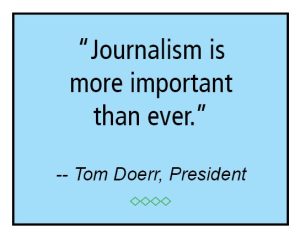
That’s why journalism is more important than ever. Reporters must examine official claims, trace the data to its source, and clarify not only what the numbers indicate but also how they are being used—or misused. Historically, governments and businesses worldwide rely on and make decisions based on data from the U.S., precisely because it is historically accurate and dependable. When government statistics are manipulated for political purposes, it is the press that must set the record straight.
 But even journalists can’t prevent the damage when presidents govern based on belief rather than facts. That responsibility rests with all of us. America needs more people to voice outrage over a lack of transparency and honesty.
As citizens, we must insist that government data be shielded from political meddling. We should back whistleblowers who risk their careers to speak truth to power. And we need to reject the lazy cynicism that assumes every expert has bias and every agency is corrupt. Such general distrust is exactly what authoritarians thrive on—because when nothing can be trusted, everything becomes possible.
President Trump’s decision to fire a statistics official because the job numbers bruised his ego is more than just a story about one man’s insecurity. It’s a case study in how power, when left unchecked by truth, can turn delusion into doctrine.
And here’s the irony: when a leader demands flattery over facts, he’s not just fooling the public; he’s fooling himself.
Eventually, reality reasserts itself—at the ballot box, in the economy, on the world stage. And by then, the damage is done.
Because no matter how hard you torture the numbers, the truth always comes out.
You must be logged in to post a comment.